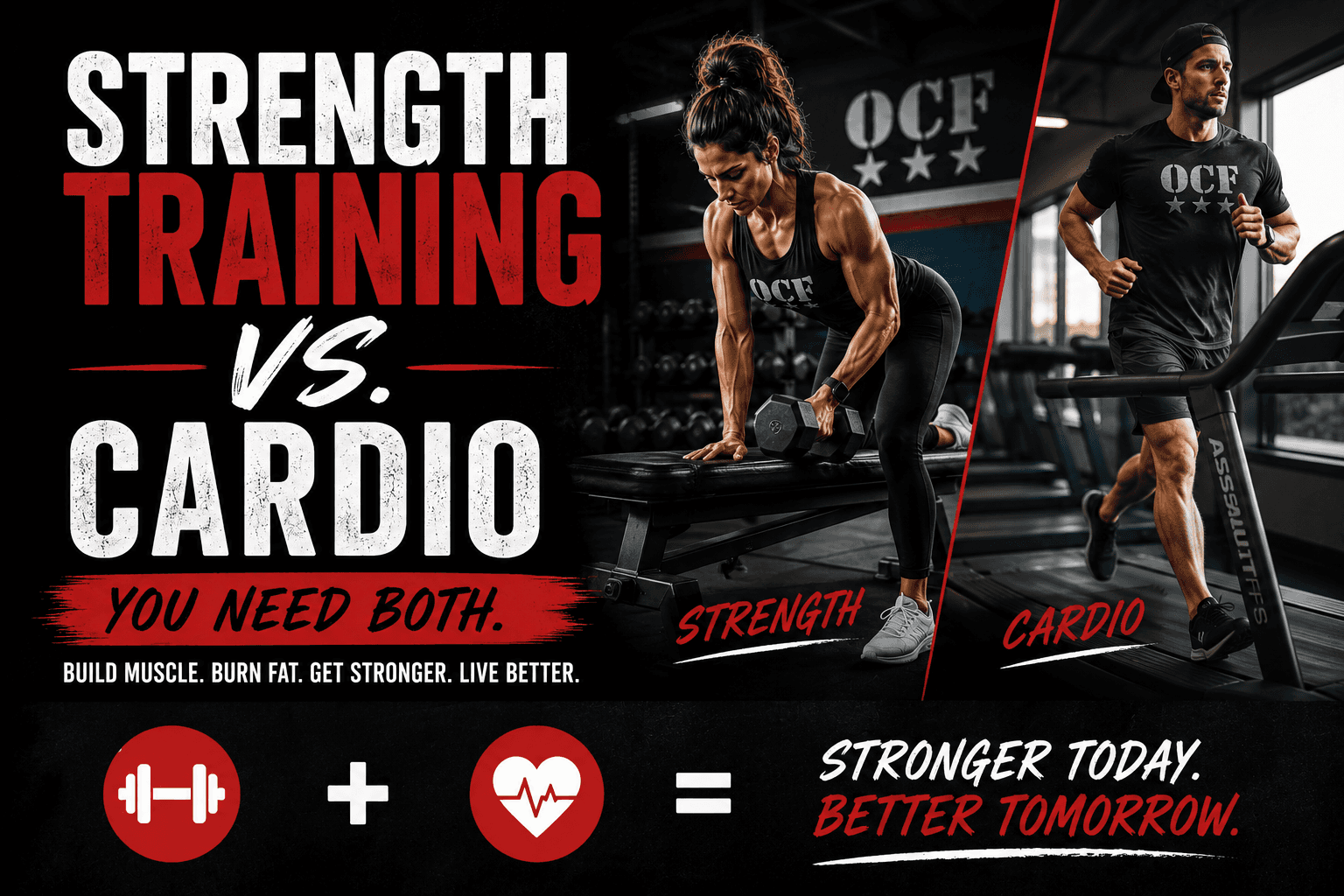
Strength Training vs. Cardio: Which Is Better for Fat Loss?
When people decide they want to lose weight, their first instinct is usually to do more cardio.
They start running, taking spin classes, or spending hours on the treadmill hoping to burn as many calories as possible.
While cardio certainly has its place, it’s only one piece of the fat-loss puzzle.
If your goal is to build a healthier, leaner body that lasts, the answer isn’t choosing between strength training and cardio. It’s understanding how each one works—and why they work better together.
What Cardio Does Well
Cardiovascular exercise is excellent for improving heart health, increasing endurance, and burning calories during your workout.
Walking, cycling, swimming, rowing, hiking, and other forms of cardio all contribute to better overall health.
For most adults, regular low- to moderate-intensity cardio is one of the best habits you can build. It supports recovery, improves cardiovascular fitness, and helps increase your daily energy expenditure without placing excessive stress on the body.
What Strength Training Does Differently
Strength training has a different purpose.
Instead of focusing primarily on calories burned during your workout, strength training helps your body build and maintain muscle.
Maintaining muscle is one of the most important factors for long-term health, improving body composition, and preserving strength as you age.
When you’re losing weight, strength training also helps reduce the amount of muscle you lose along the way. The goal isn’t simply to weigh less—it’s to lose body fat while keeping as much lean muscle as possible.
Why Muscle Matters During Fat Loss
Imagine two people who both lose 20 pounds.
One loses mostly fat while maintaining muscle.
The other loses fat but also a significant amount of muscle.
Although the scale shows the same number, their bodies will look, perform, and function very differently.
Preserving muscle helps you stay stronger, maintain better posture, perform everyday tasks more easily, and support a healthier metabolism throughout your weight-loss journey.
Do You Need High-Intensity Cardio Every Day?
Not necessarily.
Many people assume every workout has to leave them exhausted.
In reality, most people benefit more from consistent strength training combined with regular walking or other steady-state cardio than from doing intense interval workouts every day.
High-intensity training certainly has benefits, but because it’s demanding on the body, it typically works best when used strategically rather than as your only form of exercise.
The Best Approach
A well-rounded fitness program includes both.
Strength training helps build and preserve muscle.
Cardio supports heart health, endurance, recovery, and additional calorie expenditure.
When combined with proper nutrition, quality sleep, and consistency, they create a sustainable approach that improves both your appearance and your overall health.
The Bottom Line
Don’t think of strength training and cardio as competitors.
Think of them as teammates.
Cardio helps keep your heart healthy and your body moving.
Strength training helps keep your muscles strong and your body resilient.
Together, they create a healthier, stronger version of you that isn’t just lighter—but more capable for years to come.
Strength Training vs. Cardio: Which Is Better for Fat Loss?
When people decide they want to lose weight, their first instinct is usually to do more cardio.
They start running, taking spin classes, or spending hours on the treadmill hoping to burn as many calories as possible.
While cardio certainly has its place, it’s only one piece of the fat-loss puzzle.
If your goal is to build a healthier, leaner body that lasts, the answer isn’t choosing between strength training and cardio. It’s understanding how each one works—and why they work better together.
What Cardio Does Well
Cardiovascular exercise is excellent for improving heart health, increasing endurance, and burning calories during your workout.
Walking, cycling, swimming, rowing, hiking, and other forms of cardio all contribute to better overall health.
For most adults, regular low- to moderate-intensity cardio is one of the best habits you can build. It supports recovery, improves cardiovascular fitness, and helps increase your daily energy expenditure without placing excessive stress on the body.
What Strength Training Does Differently
Strength training has a different purpose.
Instead of focusing primarily on calories burned during your workout, strength training helps your body build and maintain muscle.
Maintaining muscle is one of the most important factors for long-term health, improving body composition, and preserving strength as you age.
When you’re losing weight, strength training also helps reduce the amount of muscle you lose along the way. The goal isn’t simply to weigh less—it’s to lose body fat while keeping as much lean muscle as possible.
Why Muscle Matters During Fat Loss
Imagine two people who both lose 20 pounds.
One loses mostly fat while maintaining muscle.
The other loses fat but also a significant amount of muscle.
Although the scale shows the same number, their bodies will look, perform, and function very differently.
Preserving muscle helps you stay stronger, maintain better posture, perform everyday tasks more easily, and support a healthier metabolism throughout your weight-loss journey.
Do You Need High-Intensity Cardio Every Day?
Not necessarily.
Many people assume every workout has to leave them exhausted.
In reality, most people benefit more from consistent strength training combined with regular walking or other steady-state cardio than from doing intense interval workouts every day.
High-intensity training certainly has benefits, but because it’s demanding on the body, it typically works best when used strategically rather than as your only form of exercise.
The Best Approach
A well-rounded fitness program includes both.
Strength training helps build and preserve muscle.
Cardio supports heart health, endurance, recovery, and additional calorie expenditure.
When combined with proper nutrition, quality sleep, and consistency, they create a sustainable approach that improves both your appearance and your overall health.
The Bottom Line
Don’t think of strength training and cardio as competitors.
Think of them as teammates.
Cardio helps keep your heart healthy and your body moving.
Strength training helps keep your muscles strong and your body resilient.
Together, they create a healthier, stronger version of you that isn’t just lighter—but more capable for years to come.
Strength Training vs. Cardio: Which Is Better for Fat Loss?
When people decide they want to lose weight, their first instinct is usually to do more cardio.
They start running, taking spin classes, or spending hours on the treadmill hoping to burn as many calories as possible.
While cardio certainly has its place, it’s only one piece of the fat-loss puzzle.
If your goal is to build a healthier, leaner body that lasts, the answer isn’t choosing between strength training and cardio. It’s understanding how each one works—and why they work better together.
What Cardio Does Well
Cardiovascular exercise is excellent for improving heart health, increasing endurance, and burning calories during your workout.
Walking, cycling, swimming, rowing, hiking, and other forms of cardio all contribute to better overall health.
For most adults, regular low- to moderate-intensity cardio is one of the best habits you can build. It supports recovery, improves cardiovascular fitness, and helps increase your daily energy expenditure without placing excessive stress on the body.
What Strength Training Does Differently
Strength training has a different purpose.
Instead of focusing primarily on calories burned during your workout, strength training helps your body build and maintain muscle.
Maintaining muscle is one of the most important factors for long-term health, improving body composition, and preserving strength as you age.
When you’re losing weight, strength training also helps reduce the amount of muscle you lose along the way. The goal isn’t simply to weigh less—it’s to lose body fat while keeping as much lean muscle as possible.
Why Muscle Matters During Fat Loss
Imagine two people who both lose 20 pounds.
One loses mostly fat while maintaining muscle.
The other loses fat but also a significant amount of muscle.
Although the scale shows the same number, their bodies will look, perform, and function very differently.
Preserving muscle helps you stay stronger, maintain better posture, perform everyday tasks more easily, and support a healthier metabolism throughout your weight-loss journey.
Do You Need High-Intensity Cardio Every Day?
Not necessarily.
Many people assume every workout has to leave them exhausted.
In reality, most people benefit more from consistent strength training combined with regular walking or other steady-state cardio than from doing intense interval workouts every day.
High-intensity training certainly has benefits, but because it’s demanding on the body, it typically works best when used strategically rather than as your only form of exercise.
The Best Approach
A well-rounded fitness program includes both.
Strength training helps build and preserve muscle.
Cardio supports heart health, endurance, recovery, and additional calorie expenditure.
When combined with proper nutrition, quality sleep, and consistency, they create a sustainable approach that improves both your appearance and your overall health.
The Bottom Line
Don’t think of strength training and cardio as competitors.
Think of them as teammates.
Cardio helps keep your heart healthy and your body moving.
Strength training helps keep your muscles strong and your body resilient.
Together, they create a healthier, stronger version of you that isn’t just lighter—but more capable for years to come.


START YOUR 2-WEEK FREE PASS
Try ObstaCourse free. Meet the coaches, feel the community, and find your fit before you commit. No pressure, all support.

START YOUR 2-WEEK FREE PASS
Try ObstaCourse free. Meet the coaches, feel the community, and find your fit before you commit. No pressure, all support.
START YOUR 2-WEEK FREE PASS
Try ObstaCourse free. Meet the coaches, feel the community, and find your fit before you commit. No pressure, all support.